


Bangkok, 26 February 2026 – The National Innovation Agency (Public Organisation) (NIA) is advancing a national strategy to transform Thailand’s beef industry from a volume-driven sector into a high-value, premium economy, strengthening the country’s food soft power and global competitiveness. As consumer preferences shift toward quality, traceability, and brand identity, Thailand’s premium beef market is expanding rapidly. In response, NIA is driving a transition from volume-based production to a value-based model—similar to global industries such as wine and specialty coffee—by embedding innovation across the entire value chain.
Dr. Krithpaka Boonfueng, Executive Director of the NIA, revealed that Thailand’s beef industry has high potential and growth opportunities. However, it has historically faced limitations regarding standards and access to high-value markets. A significant gap exists as Thailand’s average beef consumption is only about 3.24 kilograms per person per year, yet the demand for premium beef is rising. Consequently, the country imports over 7 billion baht of high-quality beef annually, signalling that domestic production capacity cannot yet meet market demand.
Looking at the broader landscape, the global beef industry is entering a major transition, shifting from basic commodities to high-value, identity-driven products. Expanding purchasing power and population growth are driving continuous demand for high-quality protein. The global quality beef market is projected to reach USD 712.5 billion by 2030, with a compound annual growth rate (CAGR) of 4.4%. Meanwhile, the high-end beef segment, valued at USD 341.73 billion in 2024, is expected to grow to USD 449.79 billion by 2033 (CAGR 3.1%). This growth reflects changing consumer behaviour, with increasing emphasis on texture, food safety, and overall consumption experience—key factors accelerating the expansion of the premium beef segment beyond the general commodity market.
Dr. Krithpaka added that NIA aims to increase the commercial competitiveness of the beef industry, covering everything from breed development, farm management, nutrition, and post-slaughter technology to processing, branding, marketing, and creating new consumer experiences. The goal is to upgrade traditional Thai beef production—which focuses on selling by weight at an average of 80–82 baht per kilogram—to a premium market where farmers can sell meat at 105–145 baht per kilogram. This shifts the industry’s revenue structure from a Volume-Based model to a Value-Based model capable of competing with high-quality foreign beef. The development direction for Thai beef will focus on Deep Innovation, including precision breeding suited to Thailand’s climate, data and IoT-enabled farm management, scientific aging processes to enhance flavour, sustainable production practices to reduce carbon footprint, and strong storytelling tied to geographic identity. The result is Thai beef that offers a distinctive balance: rich marbling without excessive fattiness, freshness from domestic production, and internationally aligned safety standards.
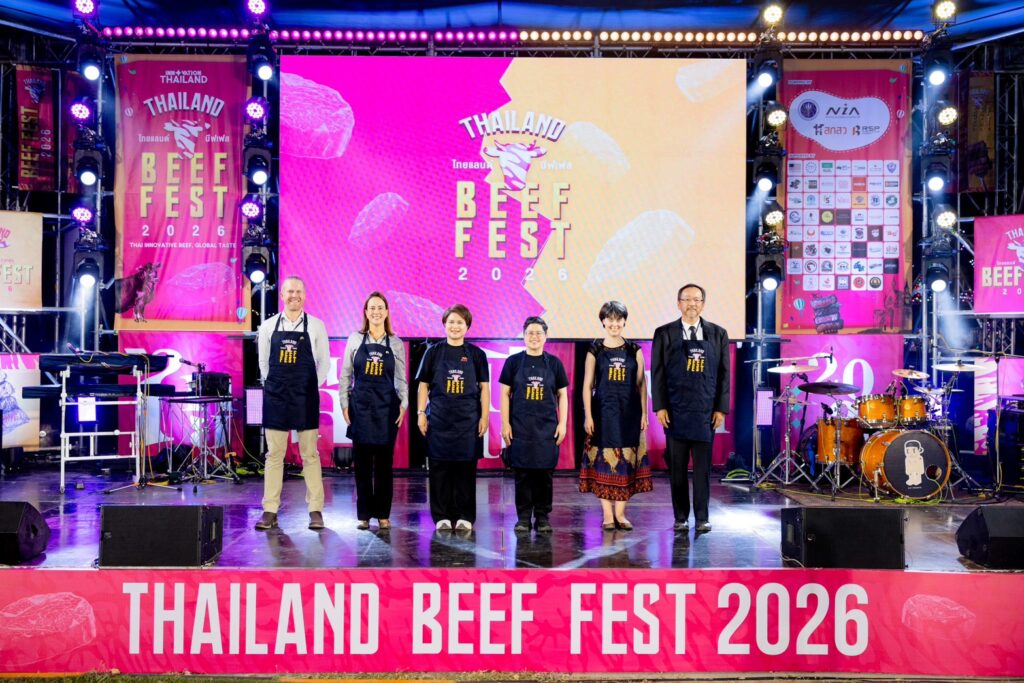
A key example of this policy in action is “Thailand Beef Fest”, which serves as a national platform to accelerate industry growth. The event demonstrates how innovation can translate into real market opportunities by connecting Thai producers with buyers, chefs, and international partners. It provides a space for knowledge exchange, business matching, and consumer engagement—helping Thai entrepreneurs scale beyond local markets and compete internationally.
NIA is also highlighting four flagship Thai premium beef brands that reflect the country’s innovation-driven approach and regional identity: Korat Black (Lam Takhong, Nakhon Ratchasima) – Developed through triple crossbreeding (Wagyu, Angus, and native Thai cattle), this beef delivers a balanced texture—tender yet not overly rich. Precision nutrition using local agricultural inputs enhances both flavour and sustainability. Surin Wagyu (Salak Dai, Surin – GI Certified) – A community-driven success story, this hybrid Wagyu features over 50% Wagyu genetics. Its signature lies in feed innovation using jasmine rice byproducts and probiotics, producing fine marbling and a distinct nutty, aromatic fat. Nong Sung Beef (Mukdahan) – Backed by cooperative farming and international standards, this brand emphasizes bold, beef-forward flavour. With full traceability and halal-certified processing, it caters to both domestic and export markets through diverse product offerings. Kamphaeng Saen Beef (Nakhon Pathom – GI Certified) – A pioneer in Thai beef innovation, this breed was scientifically developed by Kasetsart University. Its hallmark is advanced aging technology that enhances umami depth, delivering consistently tender and refined flavour.
Through this integrated policy approach, NIA aims to redefine Thai beef from a traditional agricultural product into a premium global offering—driving economic growth, enhancing farmer livelihoods, and establishing Thailand as a rising player in the global premium beef market.




ใส่ความเห็น